













January 06, 2026
0 comments


For many European homeowners, a home sauna is a long-term investment in health, comfort and property quality. Unlike most wellbeing products, a sauna runs at high temperatures for long periods, often between 70 and 90 °C. In these conditions, the choice of materials, surface treatments and construction methods matters far more than in ordinary indoor spaces. A healthy home sauna isn't defined by marketing claims, but by how it manages heat, air and materials in a way that supports indoor air quality across decades of use.
In recent years, consumers have become more aware of indoor air quality, volatile organic compounds and chemical emissions from building products. This concern is well founded. Heat accelerates chemical reactions and increases off-gassing, which means materials that are acceptable in ordinary living spaces can behave very differently inside a sauna. The Nordic countries have long addressed this reality through conservative material choices, simple construction principles and clear guidance from public-health and building-research institutions.
This article explains how to avoid harmful materials in a healthy home sauna, which standards genuinely matter in Europe and how careful design protects indoor air quality when temperatures rise. It also clarifies how Nordic manufacturing practices align with these principles, so that buyers can make informed decisions without fear-based language or unrealistic promises.
Why indoor air quality matters more in a sauna than in other rooms
Indoor air quality is shaped by temperature, humidity, ventilation and material emissions. A sauna combines all four at once. According to guidance from the Finnish Institute of Occupational Health, higher temperatures significantly increase the rate at which volatile organic compounds are released from many building materials, even when those materials meet general indoor standards at room temperature (Finnish Institute of Occupational Health, 2019).
In a living room at 20 to 22 °C, emissions from adhesives, coatings and composite boards remain relatively stable. In a sauna at 80 °C, those same materials can release higher concentrations of airborne compounds. That is why traditional Nordic sauna design treats the hot room as a special environment with its own rules, rather than simply another indoor space.
Ventilation amplifies this effect further. A sauna depends on controlled air exchange to maintain oxygen levels and even heat distribution. Poor material choices can introduce unwanted substances directly into that airflow. A healthy home sauna therefore relies on low-emission materials, simple untreated surfaces and predictable airflow paths, rather than sealants, varnishes or complex layered panels.
What people usually mean by "toxic" in the context of a sauna
Consumers often search for terms like "non-toxic sauna" or "toxin-free sauna". In practice, these phrases usually reflect concern about a few specific issues, rather than a single defined risk.
Most concerns relate to:
- Off-gassing from glues and composite panels
- Chemical finishes or varnishes under heat
- Synthetic insulation or sealants exposed to high temperatures
- Uncertainty about imported products with unclear material documentation
There is no formal European definition of a "non-toxic sauna". Instead, there are well-established principles for minimising emissions and protecting indoor air quality. Nordic construction guidance focuses on reducing emission sources rather than trying to eliminate all chemistry from a space, which is neither realistic nor necessary.
A healthy home sauna follows these principles by limiting materials to those proven safe under sustained heat, keeping adhesives and treatments out of the hottest zones, and relying on ventilation rather than coatings to control humidity.
Nordic health guidance on sauna temperatures and materials
Finland provides some of the most comprehensive public guidance on sauna use and construction in Europe. The national guidelines from the Finnish Institute for Health and Welfare recommend traditional sauna temperatures of 70 to 90 °C for healthy adults and emphasise adequate ventilation and appropriate materials to maintain comfort and safety (THL, 2022).
Material guidance complements this advice. The wood guidance from the Natural Resources Institute Finland highlights aspen, alder and spruce as suitable woods for the sauna interior thanks to their low resin content, dimensional stability and neutral behaviour under heat (Luke, 2020). These woods have been used for generations in Nordic saunas precisely because they perform predictably without surface treatments.
Research from the Technical Research Centre of Finland (VTT) has also examined emissions from building materials under elevated temperatures, supporting the long-standing practice of avoiding composite panels and unnecessary surface coatings inside the hot room (VTT, 2018).
The role of solid wood in a healthy home sauna
Solid wood remains the foundation of healthy sauna construction. Unlike engineered panels, solid boards don't depend on adhesives or internal binders. When properly dried and installed, they expand and contract evenly under heat, reducing stress and avoiding cracks that could trap moisture.
In a healthy home sauna, solid wood plays several roles at once. It regulates humidity, stays comfortable to the touch and contributes minimal odour when heated. Its behaviour is well understood, which is why Nordic standards continue to favour traditional species over newer engineered alternatives.
Aspen for sauna interior surfaces
Aspen is widely used in Nordic sauna interiors because it contains no resin and stays cool to the touch, even at high temperatures. According to the Natural Resources Institute Finland, aspen's pale colour and fine grain make it particularly well suited to benches and wall panels where direct skin contact occurs (Luke, 2020).
From an indoor air quality perspective, aspen emits very low natural odours and requires no surface treatment. That makes it a strong choice for those who prioritise a healthy home sauna environment.
Alder as a durable, stable alternative
Alder offers slightly higher density than aspen and a warmer reddish tone. It is naturally water-repellent and dimensionally stable, making it suitable for both wall panels and benches. Like aspen, alder performs well without coatings and releases no resin under heat.
Nordic manufacturers often use alder in premium sauna cabins, where longevity and visual warmth are priorities, without compromising indoor air quality.
Spruce for structure and walls
Spruce has traditionally been used for sauna walls and ceilings, particularly in the Nordic countries. While it contains small amounts of resin, properly selected and kiln-dried spruce boards release minimal odour at sauna temperatures. Guidance from Finnish forestry authorities indicates that spruce remains acceptable for sauna interiors when sourced and processed correctly (Luke, 2020).
Norway spruce is generally avoided for benches where skin contact is prolonged, but it remains a practical and healthy option for structural interior surfaces.
Why composite panels and plywood are avoided in hot zones
Composite wood products such as plywood, MDF and veneered panels rely on adhesives to bond the layers. These adhesives are typically designed for room-temperature environments. Under sustained heat, their emission profiles can change.
Studies on indoor air quality in high-temperature environments have shown that certain adhesives release higher concentrations of formaldehyde and other VOCs when heated beyond their intended range (VTT, 2018). While many modern products meet EU standards for general indoor use, those standards weren't designed for sauna conditions.
This is why Nordic sauna construction keeps composite panels entirely out of the hot room. In a healthy home sauna, solid wood boards are used on every interior surface exposed to heat, while structural panels or insulation layers sit behind vapour barriers and outside the main airflow.
Adhesives and fasteners in healthy sauna construction
No sauna is built without fasteners or some form of adhesive. The difference lies in where and how they are used. In Nordic practice, adhesives are kept out of the hot zone wherever possible. Mechanical fastening is preferred for benches and wall panels, allowing components to move naturally with temperature changes.
Where adhesives are unavoidable, they are selected for stability at high temperatures and placed behind insulation or vapour barriers. This reduces direct exposure to heat and airflow. According to Finnish construction guidance, this approach minimises emissions while maintaining structural integrity (Finnish Ministry of the Environment, 2020).
A healthy home sauna doesn't rely on glued interior panels or laminated surfaces to achieve visual consistency. Instead, it accepts the natural variation of wood as part of its function.
Surface treatments, oils and finishes under heat
One of the most common misconceptions is that sauna interior wood needs to be sealed to protect it. In the Nordic countries, the opposite approach is often taken. Untreated wood lets moisture evaporate freely, reducing the risk of trapped damp and microbial growth.
Where treatments are used, they are limited to sauna-approved paraffin oils, applied sparingly and mainly on the benches. These oils are designed to withstand high temperatures without releasing significant odours or emissions. National consumer guidance in Finland emphasises that interior varnishes and lacquers are unsuitable for sauna hot rooms because of how they behave under heat (THL, 2022).
A healthy home sauna therefore avoids glossy finishes and relies on routine cleaning and ventilation rather than chemical coatings.
Ventilation as a health and air-quality control
Ventilation is just as important as material choice when it comes to protecting indoor air quality. Even low-emission materials need adequate air exchange to maintain oxygen levels and remove humidity.
Traditional Nordic sauna ventilation introduces fresh air near the heater and expels it on the opposite side, creating a gentle circulation pattern. Research from the University of Eastern Finland has shown that adequate ventilation improves comfort and reduces perceived air-quality issues during sauna bathing (University of Eastern Finland, 2019).
Inadequate ventilation can concentrate odours and humidity, making even well-chosen materials unpleasant. A healthy home sauna design therefore integrates ventilation from the start, rather than treating it as an afterthought.
Insulation and vapour barriers without chemical exposure
Behind the visible wood surfaces, insulation and vapour barriers play a key role. In European construction, mineral wool insulation is commonly used for sauna walls and ceilings because of its non-combustibility and thermal stability. When properly installed behind an aluminium vapour barrier, it remains isolated from the hot room air.
Finnish building regulations require vapour barriers to prevent moisture migration into structural elements, reducing long-term damage and mould risk (Finnish Ministry of the Environment, 2020). These layers are not exposed to direct heat or airflow, limiting any potential impact on indoor air quality.
The core principle is separation. In a healthy home sauna, materials not intended for high temperatures sit outside the thermal and airflow envelope.
Electric heaters, materials and air quality
Electric sauna heaters are the most common choice in European homes. When properly certified, they don't introduce combustion gases or particulates into the sauna. CE-marked heaters comply with EU electrical and safety standards and are designed to operate within defined temperature ranges.
From an indoor air quality perspective, the heater itself should be built from stainless steel and mineral components that tolerate heat without degradation. Finnish safety guidance emphasises the importance of correctly sizing the heater to avoid excessive surface temperatures and uneven heating, which can stress the surrounding materials (Tukes, 2021).
A healthy home sauna uses a heater sized to the room volume, reducing thermal extremes and supporting steady air circulation.
Wood-burning heaters and indoor air considerations
Wood-burning sauna heaters remain popular in rural settings and outdoor saunas. When properly installed, they can deliver excellent heat quality. However, they introduce additional considerations for indoor air quality.
Combustion requires proper flue design, clearances and a fresh-air supply. Finnish fire-safety guidance points out that poorly designed flues or insufficient air intake can lead to smoke leakage and reduced air quality (Finnish National Rescue Association, 2020).
For indoor residential settings, electric heaters are generally easier to integrate into a healthy home sauna thanks to their predictable emission profile and simpler ventilation requirements.
Infrared saunas and material claims
Infrared saunas operate at lower air temperatures, but they still expose interior materials to radiant heat. While some marketing campaigns suggest they are inherently safer from an emissions standpoint, the same material principles apply.
Low-quality infrared cabins often rely on composite panels and interior coatings. Research reviews from Nordic consumer organisations note that material transparency and build quality vary widely in this category (Swedish Consumer Agency, 2021).
A healthy home sauna, whether traditional or infrared, depends on material quality and construction, not on the heating method alone.
Health benefits associated with traditional sauna use
A healthy home sauna supports wellbeing when used appropriately. A major cohort study from the University of Eastern Finland linked frequent sauna use to lower cardiovascular mortality and improved circulatory markers in middle-aged adults (University of Eastern Finland, 2018). These benefits are tied to traditional sauna temperatures and regular use, not to any specific claim about materials.
Maintaining good indoor air quality ensures the sauna environment supports relaxation and respiratory comfort, rather than irritation. While sauna use is generally well tolerated by healthy adults, public-health guidance emphasises the importance of listening to your body and avoiding sessions during illness or dehydration (THL, 2022).
The benefits often associated with regular sauna use include:
- Relaxation and stress reduction
- Improved circulation during heat exposure
- Subjective improvements in sleep quality
- Temporary relief from muscle tension
These effects depend on a comfortable, well-ventilated environment, not on aggressive heat or chemical treatments.
Comparing common approaches to sauna materials
A brief comparison helps clarify why traditional Nordic construction remains the benchmark for a healthy home sauna.
- Solid wood boards versus composite panels
- Untreated interiors versus varnished surfaces
- Mechanical fastening versus glued assemblies
- Ventilated design versus sealed cabins
Each of these choices influences how materials behave under heat and how indoor air quality is maintained over time.
Installation, certification and material transparency
In Europe, installing a healthy home sauna involves more than the cabin itself. Electrical work must comply with national regulations, typically requiring a certified electrician for heater connections beyond standard socket loads. Building regulations may also apply when modifying structural walls or adding ventilation ducts.
Material transparency matters at this stage. Reputable manufacturers provide documentation on wood species, heater certifications and compliance with EU safety standards. While not every component carries a separate emissions label, Nordic suppliers often align with the Finnish M1 classification system for low-emission building materials, which is widely respected across Europe (Building Information Foundation RTS, 2021).
Choosing a supplier familiar with these standards reduces uncertainty and supports long-term indoor air quality.
Energy use and indoor-air comfort
Energy efficiency indirectly influences comfort. An underpowered heater struggles to reach target temperatures, leading users to extend heating times and overload the materials. An oversized heater can create steep temperature gradients and localised overheating.
Finnish energy guidance suggests matching heater output to room volume and insulation quality to achieve steady heat with moderate energy use (Motiva, 2022). Steady heat supports predictable material behaviour and comfortable airflow, contributing to a healthy home sauna environment.
Design considerations for small and urban homes
In flats and compact homes, space constraints make material choice even more important. Smaller volumes heat up faster, amplifying emission rates if unsuitable materials are used. That is why Nordic manufacturers emphasise conservative construction for compact saunas.
Integrating a sauna into a bathroom or utility space requires careful separation of damp zones and clear ventilation paths. European building guidance recommends dedicated ventilation rather than relying on shared bathroom extraction systems (Finnish Ministry of the Environment, 2020).
A healthy home sauna in an urban setting prioritises simplicity, airflow and proven materials over decorative complexity.
Maintenance practices that support air quality
Even the best materials need basic care. Regular cleaning of the benches with mild soap and water removes sweat residue that can cause odours. Periodic ventilation after use lets humidity dissipate.
Public-health guidance in Finland advises against using harsh chemical cleaners in saunas, as residues can volatilise under heat (THL, 2022). Simple maintenance preserves both the materials and indoor air quality.
How these principles guide our sauna selection
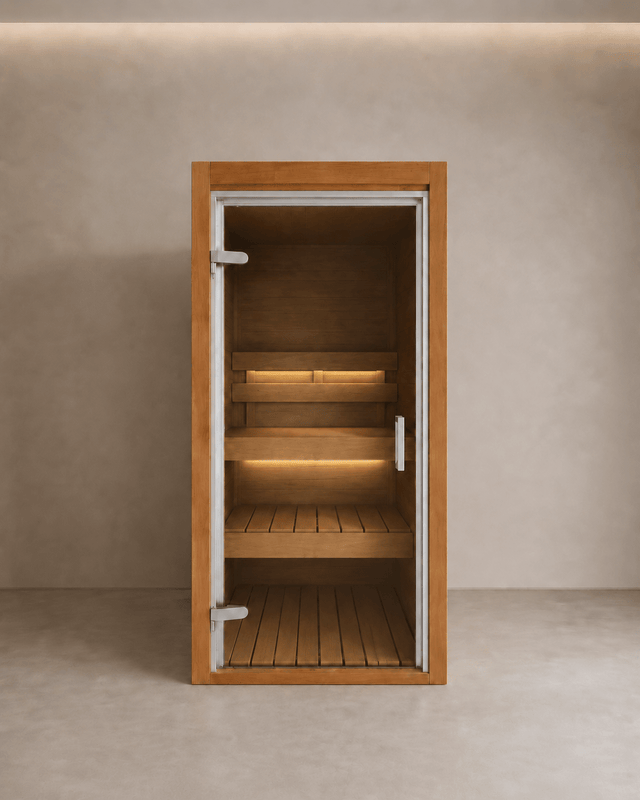
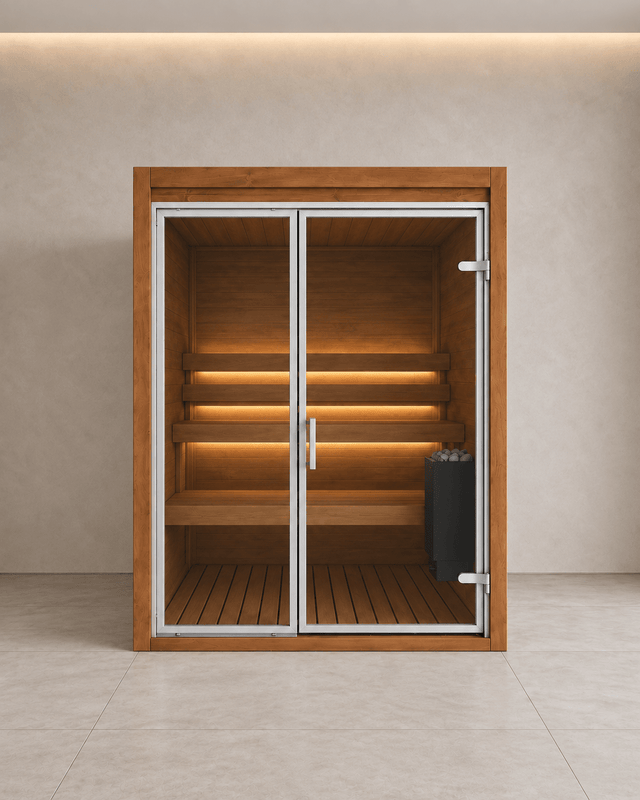
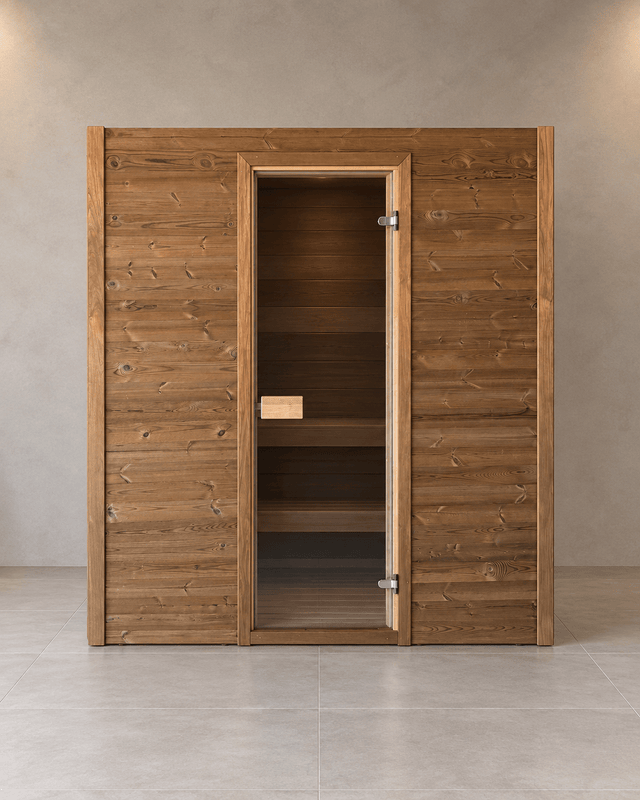
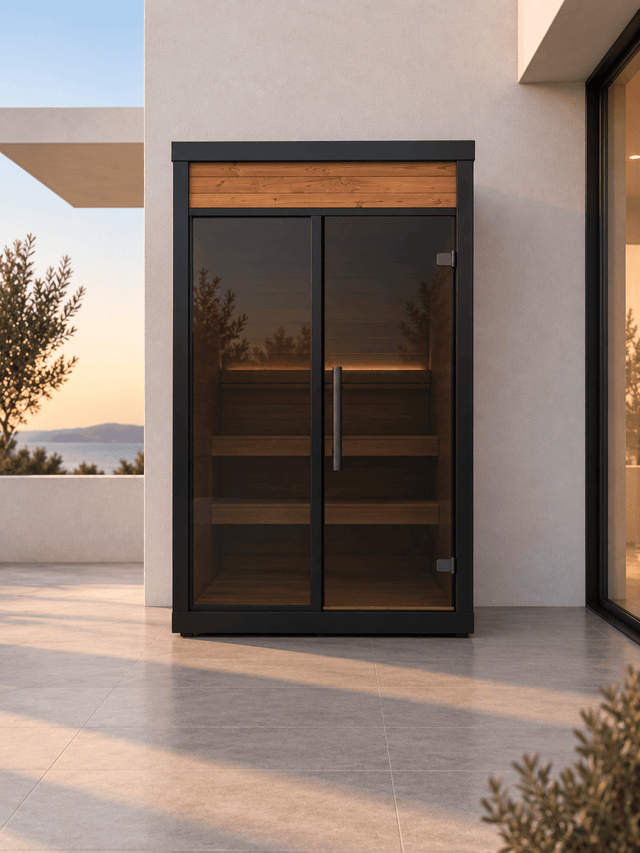
Our sauna cabins are built with solid aspen, alder or spruce for every interior surface exposed to heat. Interior panels and benches are left untreated or finished only with sauna-approved products where necessary. Composite boards, interior varnishes and decorative laminates are avoided in the hot room.
Heaters
are CE-certified for EU use and sized to room volume, supporting steady temperatures and controlled airflow. Construction follows the Nordic best practices developed in environments where sauna use is frequent and long established.
This approach reflects established health and construction guidance, rather than marketing trends.
Serving European homes with a focus on health
We supply sauna solutions across the European Union and work with customers planning installations in a wide range of climates and building types. Popular among customers in Portugal and Spain, our approach emphasises materials and construction methods suited to high temperatures and long-term indoor-air comfort.
Checklist for buying a healthy home sauna
Before choosing a sauna, it helps to review a few practical criteria focused on health and air quality.
- Solid aspen, alder or spruce wood interiors
- Minimal use of adhesives in the hot room
- No interior varnishes or decorative coatings
- Clear ventilation design with intake and exhaust
- Certified heater sized to the room volume
These factors matter more than surface aesthetics when temperatures rise.
Conclusion: health comes from design, not slogans
A healthy home sauna is the result of deliberate design choices, grounded in decades of Nordic experience. By prioritising solid wood materials, avoiding unnecessary chemical treatments and ensuring adequate ventilation, indoor air quality can be protected even under prolonged heat.
Rather than seeking absolute claims, homeowners benefit from understanding how materials behave under real sauna conditions. This knowledge supports better decisions, longer-lasting installations and a sauna environment that stays clean, comfortable and consistent over time.
Browse our sauna collection: /collections/saunas
Quick takeaways
- Heat increases material emissions, making sauna-specific choices essential
- Solid wood interiors support stable indoor air quality
- Ventilation is as important as material selection
- Nordic standards emphasise simplicity and predictability
- Long-term health depends on design, not coatings
Explore our products
Find the right heater for your sauna:
Related post

How much does it cost to run an electric sauna at home in Europe — and how Saunamo helps lower yours
Healthy home saunas: how to avoid harmful materials and protect indoor air quality under heat

More than just a home: do saunas and spas raise property values in Europe?

From Heat to Rest: How the Sauna Helps You Sleep Deeper


