












October 02, 2024
0 comments


Choosing a home sauna is less about deciding which technology is “better” than deciding which kind of heat you want to live with. A traditional sauna builds a hot room around you: an electric heater warms a mass of stones, the stones and surrounding surfaces radiate heat, and the air temperature rises. Add water to the stones and you change the humidity and the way that heat feels almost instantly. An infrared cabin works differently. Radiant panels are positioned around the seated user and operate at lower air temperatures, while the cabin air and interior surfaces warm as the session continues.
That distinction changes almost everything that matters once the sauna is in your home: how quickly you are likely to use it on a weekday evening, whether you want to control humidity with löyly, how much floor space the cabin consumes, where the heat comes from around your body, what electrical work is required and how much maintenance becomes part of the routine.
For homeowners in Portugal or Spain, where an indoor sauna is often being fitted into an existing bathroom, gym, spare room or wellness area rather than designed into a new Nordic-style sauna suite, those practical differences can matter more than headline temperature figures. The right choice is the one whose ritual, dimensions and servicing requirements still make sense after the novelty of installation has passed.
Infrared sauna vs traditional sauna: the decision begins with the heat
A traditional electric sauna uses a heater and stones to create a hot environment. The heater warms the stones and air; the hot stones, timber and other surfaces also contribute radiant heat. Once the room has reached bathing temperature, the user can throw water onto the stones to create löyly. That brief increase in water vapour changes perceived heat dramatically even though the thermostat has not suddenly raised the room temperature.
This is why reducing a traditional sauna to “hot air” misses an important part of the experience. Radiation from the heater and hot enclosure surfaces, convection from the heated air and, during löyly, heat transfer associated with water vapour all contribute to what you feel. The balance changes during the session as the stones, walls, benches and air reach temperature.
An infrared cabin starts from the other direction. Its emitters produce infrared radiation towards the occupant and nearby surfaces. The surrounding air still warms, and warmed cabin surfaces subsequently radiate heat too, so “infrared heats only the body, not the air” is not an accurate description of what happens in a real enclosure. Experimental work on low-temperature radiant saunas has found heat transfer to involve both convection from warmed air and radiation from surrounding surfaces rather than a simple beam travelling exclusively from emitter to body.
That also makes fixed claims about infrared penetrating a precise depth into human tissue a poor basis for choosing a cabin. Wavelength, emitter temperature, distance, skin properties, clothing and the thermal environment all affect exposure. For a homeowner, the more useful questions are simpler: where are the emitters positioned, how close are they to the seated body, what temperature range does the actual model use and does that style of sustained radiant warmth appeal to you?
Saunamo’s current Aura models illustrate the point. The Aura 110 is listed with three full-spectrum panels plus a lower heating element, while the Aura 150 uses four full-spectrum panels and two heating plates beneath the bench. In other words, cabin layout and emitter position are part of the experience; infrared is not simply a lower-temperature version of a stone-heated sauna.
What the two experiences actually feel like
Traditional sauna offers more variables to play with. You can choose a lower or higher air temperature, sit higher or lower if the bench design permits it, alter the amount and timing of löyly and let the stones recover between rounds. Manufacturer guidance commonly describes traditional sauna bathing at approximately 80–100°C, although there is no single correct setting and many people prefer lower temperatures with more frequent water on the stones.
That variability is the attraction for many owners. A traditional sauna can move from comparatively dry heat to a much more enveloping sensation in seconds. It also lends itself to rounds: heat, step out, cool down, return and adjust the next round to taste. If the ability to throw water on hot stones is central to what you mean by “sauna”, infrared will not reproduce it.
Infrared is generally steadier. Saunamo currently states that the Aura 110 and Aura 150 reach a comfortable session range of roughly 50–60°C in an estimated 10–15 minutes. Those figures should be treated as model-specific catalogue estimates rather than a universal infrared rule: starting room temperature, ventilation, placement and actual control settings all influence warm-up.
At those lower cabin temperatures, the radiant panels remain an important source of heat sensation. Where you sit therefore matters more than it might appear from a simple floor plan. A back panel, side emitter and under-bench element can create a different sensation from a cabin with most of its radiant output in front of you. When comparing infrared models, inspect the emitter layout as carefully as the quoted wattage.
Traditional seating deserves the same attention. Higher benches place the bather in hotter air, while bench depth determines whether the cabin feels genuinely comfortable for a long session or merely accommodates the advertised number of people. “Two person” is a capacity label, not a guarantee that two adults will both have generous shoulder room or be able to recline.
How much room does each type really need?
The dimensions of the enclosure matter, but they are not the dimensions of the project. You also need access for delivery, assembly, door movement, electrical work and future servicing, plus enough space in the host room for people to enter and leave comfortably.
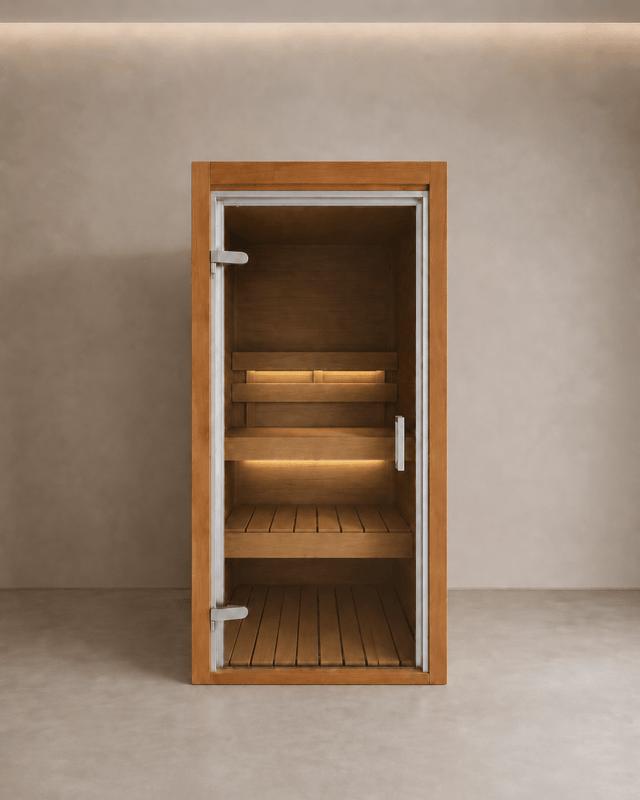
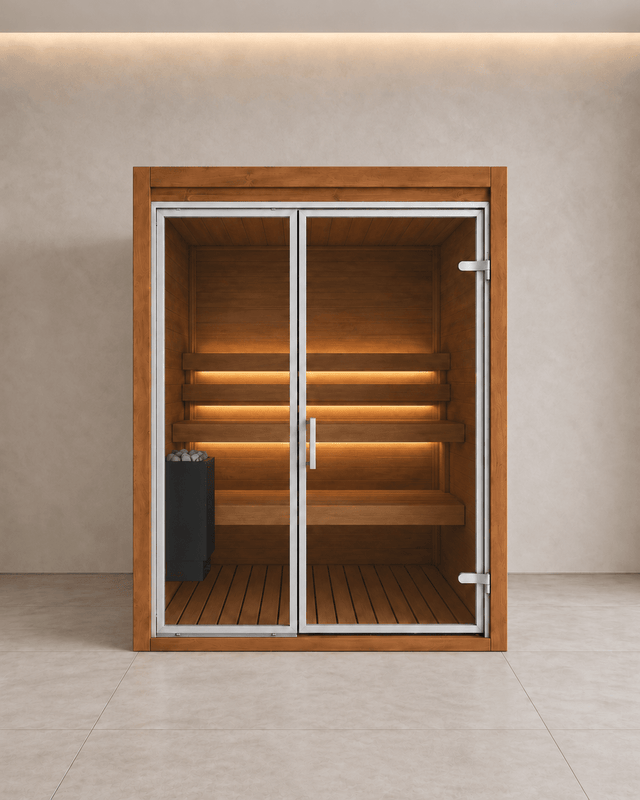
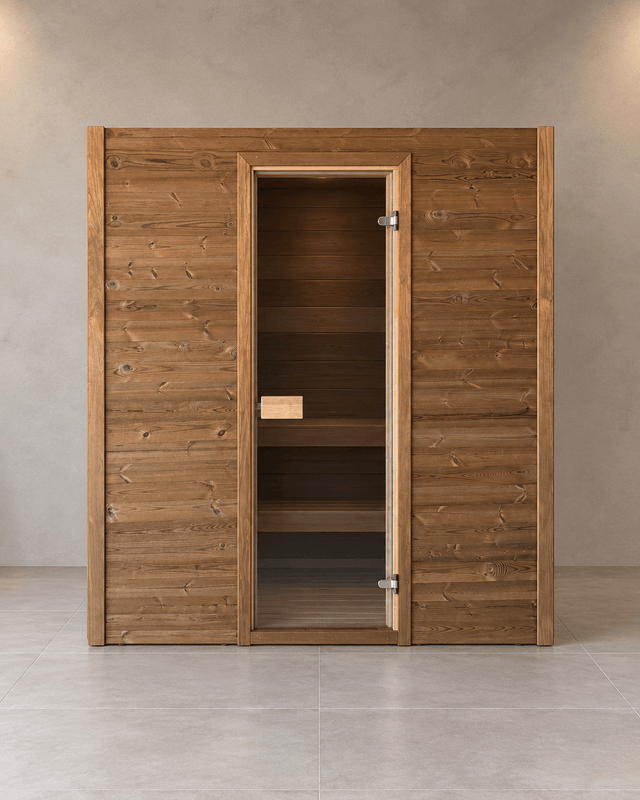
The current Saunamo range makes the comparison unusually clear. The one-person Aura 110 and Koti 1 occupy almost the same amount of floor externally, but they use that footprint differently. The two-person comparison is more pronounced: the Aura 150 is shallower than the Thermo Black 150 and therefore occupies less host-room floor area, while the traditional cabin provides substantially more internal depth.
| Model | Capacity | Exterior dimensions, W × D × H | Interior dimensions, W × D × H | Rated / specified heat system | What the dimensions mean in practice |
|---|---|---|---|---|---|
| Aura 110 infrared | 1 | 1026 × 1100 × 2100 mm | 850 × 970 × 1972 mm | 1.8 kW infrared | About 1.13 m² external footprint; compact internal depth suits seated solo use |
| Koti 1 traditional | 1 | 934 × 1200 × 2100 mm | 850 × 1150 × 2007 mm | Designed for a 3.5 kW electric heater | About 1.12 m² external footprint; nearly the same floor area as Aura 110, but with greater internal depth |
| Aura 150 infrared | 2 | 1500 × 1100 × 2100 mm | 1324 × 970 × 1972 mm | 2.4 kW infrared | 1.65 m² external footprint; shallow format can help in narrower wellness rooms |
| Thermo Black 150 traditional | 2 | 1500 × 1500 × 2150 mm | 1324 × 1370 × 2022 mm | Final heating configuration to be confirmed | 2.25 m² external footprint; considerably deeper internally and externally |
The solo comparison is a useful warning against assuming that infrared automatically saves space. The Aura 110 is shallower than the Koti 1 but wider overall, leaving their external floor areas almost identical. The two-person comparison is different: the Aura 150 saves 400 mm of depth against the Thermo Black 150, a meaningful difference in a room where circulation space is tight.
Internal dimensions matter just as much. The Aura 150’s listed interior depth is 970 mm; the Thermo Black 150’s is 1370 mm. That extra 400 mm affects how two people occupy the cabin and how the heater, benches and legroom coexist. When possible, map the internal bench dimensions and heater position rather than judging capacity from the model name alone.
Saunamo’s current indoor sauna collection is the sensible place to compare currently visible models. For rooms where a standard rectangle is awkward, the 3D sauna designer is useful for exploring dimensions, glazing, benches and layout before the technical configuration is finalised.

Installation is about the host room as well as the cabin
A prefabricated cabin is an enclosure inside another room. That distinction is important.
With an infrared cabin, there is no routine addition of water to hot stones, so the enclosure does not create the same bursts of water vapour as a traditional sauna. Saunamo currently specifies the Aura range for a level indoor room with access to 230 V single-phase power and states that no bathroom-style wet-room construction is required around it. That does not mean the surrounding room can be ignored. Occupants still sweat, the cabin rejects heat into the room and electrical components eventually need access. The host room should remain dry, ventilated and reachable for service.
Traditional sauna demands more attention to heat and moisture management inside the enclosure because löyly is part of normal use. The cabin itself must ventilate correctly, and it must be allowed to dry after use. Harvia’s guidance for electrically heated saunas calls for deliberate supply and exhaust ventilation and stresses that airflow must not interfere with the heater’s temperature sensor. Vent placement therefore belongs to the heater and cabin design, not to guesswork during installation.
The host room does not necessarily need to become a full wet room simply because it contains a prefabricated traditional sauna, but the floor, ventilation and surrounding finishes need to suit the actual installation. If the sauna is being built into the fabric of the room rather than installed as a freestanding cabin, moisture detailing becomes a building-envelope question and should be designed accordingly.
Electrical planning is similarly model-specific. The Aura 110 and 150 are currently listed for 230 V single-phase supply, but that should not be translated into “plug it into any convenient socket”. Circuit capacity, protective devices, cable routing, isolation and local electrical regulations still need checking by a qualified electrician.
A traditional heater may require a different supply depending on its power and control system. The Koti 1 is designed around a 3.5 kW heater; larger cabins commonly move into substantially higher heater outputs. The correct approach is to select the heater for the cabin volume, glazing and manufacturer requirements first, then size the supply around that actual package.
This is also where project cost begins to diverge from the advertised cabin price. Saunamo’s home-sauna cost guide separates the product price from electrical work, delivery, assembly, room preparation and heater equipment. That distinction is more useful than comparing two catalogue prices in isolation.

Ownership, cleaning and running cost
Infrared has fewer sauna-specific consumables. There are no heater stones to inspect or rearrange, and no löyly water entering the heating system. Cleaning is mainly about benches, floor, glass and the surfaces around the emitters, following the manufacturer’s instructions and keeping ventilation openings clear.
A traditional electric sauna adds heater stones to the maintenance list. Over time, repeated heating and cooling can cause stones to break down or settle, which affects airflow through the heater. They need periodic inspection according to the heater manufacturer’s guidance. After a wet session, the sauna also needs to dry properly: remove wet items, ventilate the enclosure and allow moisture from löyly and bathing to dissipate.
Neither maintenance regime is onerous if it becomes routine, but they suit different owners. Someone who wants a low-intervention heat session may prefer infrared. Someone who actively enjoys tending the sauna, adjusting löyly and using it in repeated rounds may see the traditional routine as part of the appeal rather than a burden.
Running-cost comparisons need equal care. A heater’s kW rating is power, not a bill. Energy is measured in kWh and depends on how long the equipment actually draws power. Thermostats also cycle once the target temperature is reached, so multiplying nameplate power by the entire session length can overstate real consumption. Conversely, ignoring warm-up understates it.
A transparent hypothetical example shows the arithmetic without pretending that two different sauna experiences are equivalent. If a 1.8 kW Aura 110 drew its full rated power continuously for 45 minutes, it would use:
1.8 kW × 0.75 hours = 1.35 kWh.
At an illustrative electricity price of €0.25/kWh, that would cost about €0.34.
If a 3.5 kW traditional heater drew its full rated power continuously for one hour, it would use:
3.5 kW × 1 hour = 3.5 kWh, or about €0.88 at the same hypothetical tariff.
Those figures are arithmetic examples, not measured consumption and not equivalent sessions. Actual use depends on warm-up, thermostat cycling, starting temperature, ventilation, insulation, door opening and how long the user remains inside. It would therefore be misleading to turn the nameplate comparison into a percentage “saving”.
If you are also deciding between sauna and a genuinely wet steam environment, Saunamo’s sauna-versus-steam-room guide addresses the larger differences in drainage, waterproofing, steam generation and maintenance.
Which one belongs in your home?
Choose infrared when the lower-temperature, sustained radiant experience is the thing you actually want; when rapid everyday availability matters; or when a shallower cabin solves a difficult floor plan. Pay close attention to emitter position, internal seating dimensions and the real electrical requirements of the model rather than relying on the words “full spectrum” or “plug and play”.
Choose traditional when hot air, heated stones and adjustable löyly are essential to the ritual. It offers more control over the character of each round and, in larger cabins, more scope for elevated seating and shared use. In return, you accept a heater system that needs to be properly sized and wired, stones that need occasional attention and an enclosure that must ventilate and dry well.
For a one-person room, do not assume the infrared model automatically wins on footprint: the Aura 110 and Koti 1 occupy almost identical floor areas externally. For two people, the layout question becomes clearer. The Aura 150 is appreciably shallower; the Thermo Black 150 provides substantially more internal depth.
The most useful final test is not which technology produces the most impressive specification sheet. Ask which cabin you would realistically switch on several evenings a week, which heat you would still enjoy after twenty minutes, and whether the room around it supports the way it needs to be installed and maintained. A home sauna earns its space through repeated use. Choose the ritual first, then make the building work around it.
For the next step in planning a traditional sauna, our sauna heater sizing guide explains how internal volume and glazing affect heater selection.
Related post

What size sauna heater do I need? kW, room volume and glazing

What does a home sauna really cost?

Sauna or steam room: which suits your home?

How to set up sauna + cold plunge at home


